


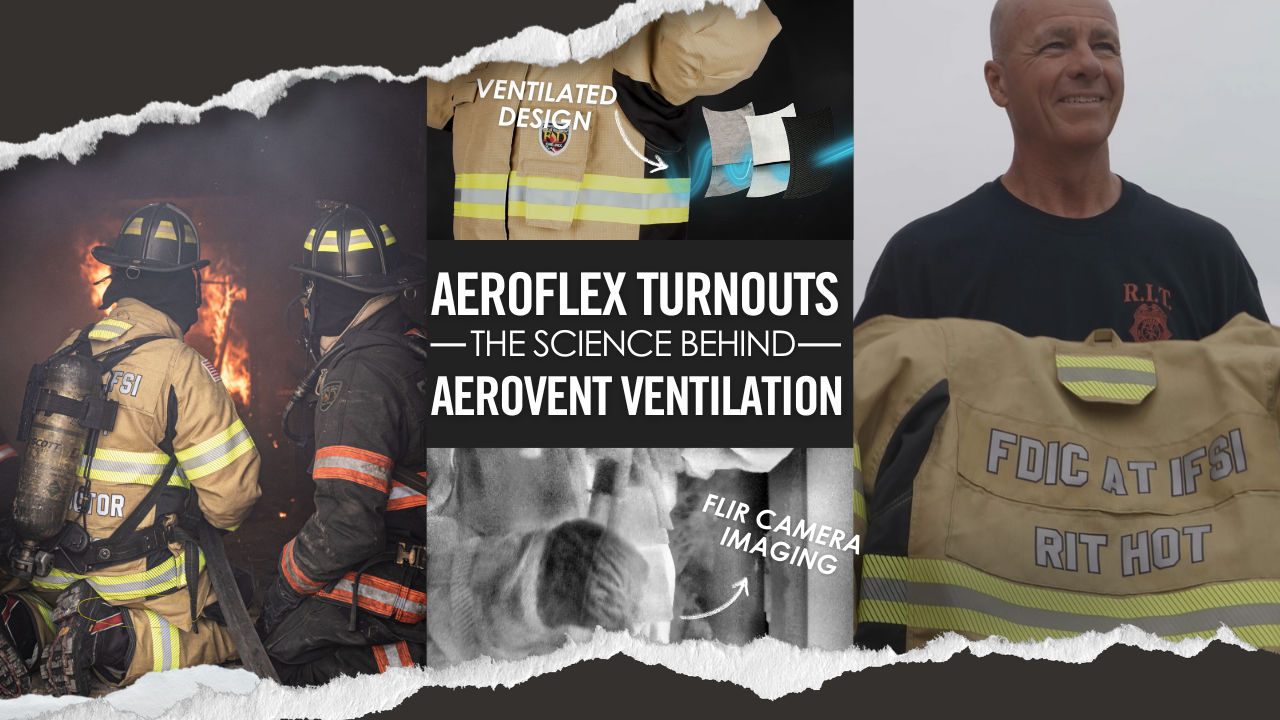
AeroFlex turnouts from Fire-Dex are the most breathable turnouts ever made. They are designed to solve a major problem for firefighters: heat stress.
When turnouts aren’t breathable, sweat vapor remains trapped inside. For sweat to cool you down, it must be able to evaporate, taking heat from off your skin and putting it out into the environment. But when sweat stays trapped, that heat stays trapped inside.
Previous research has shown what thousands of firefighters feel in AeroFlex. The vents are proven to drastically increase breathability, lowering core temperatures and reducing sweat rates.
But we wanted to show the vents working in real time. That required a specialized TIC, an imaging expert, and a live fire.
Vents Make the Difference
AeroFlex turnouts are designed with AeroVent Technology. The first of its kind, it’s a unique system that puts vents through all three layers of the turnout composite.
Those vents help push out hot sweat vapor outside turnout gear, helping to cool down the firefighter inside. There’s a slight pressure differential that creates a one-way flow where hot air can escape without letting hot air back in.
The effect is most pronounced when moving. Movement creates an effect like bellows, moving hot air out into the environment and away from the body.
Show, Don’t Tell
It’s one thing to talk about how the AeroVent system in AeroFlex helps push out hot air. But all the evidence in the world isn’t as good as seeing it in real life.
So we headed to the training facility at the Illinois Fire Safety Institute (IFSI) where we could film with live fire. The Responder Intervention Team (RIT) was on site to help us demonstrate the cooling effects of the vents.
We gave them two sets of gear, one with vents and one without, to provide a clear picture of how airflow moved.
But filming air is tricky. That’s why we teamed up with some experts from Flir.
Austin Richards, an expert in thermal imaging, brought along a specialized camera capable of seeing CO2 gas. The technology is commonly used to detect gas leaks in pipes, where CO2 is run through pipes as a tracer and filmed.
In this case, Richards provided his expertise to help us see air flowing through turnouts. We used a small CO2 canister to represent hot air inside turnouts and used the camera to show it moving through the vents and out into the environment. We used CO2 because it is the easiest to see and it demonstrates how air moves.
In the footage we captured, two firefighters stand side by side, one in gear with vents and the other in gear without vents. In the vented gear, you can clearly see CO2 gas escaping as he moves his arms during overhaul.
Takeaways
The video shows what firefighters feel. Hot air escapes but doesn’t come back in.
AeroFlex turnouts work as intended, getting hot, sweaty air out of your turnouts and away from your body so you can cool down. That can mean precious seconds between peak efficiency and overexertion, between normal core temperature and heat stress, between going home after the call or going for treatment.
You've seen the footage. What will you do with your seconds?






Leave a Reply